

When Lily came home to me at the end of February, her rooted hair was the first thing I noticed. It was soft, shiny, and laid down beautifully, and I was terrified I would be the one to ruin it. I had brushed plenty of doll hair in my years as a home economics teacher, but reborn hair is different. It is rooted into vinyl, it is usually synthetic, and it does not forgive a heavy hand. The wrong brush or a quick yank can pull the strands right out of the scalp.
I bought the Sophia's 18" Glittery Hot Pink Doll Hairbrush the first week of March, a few days after Lily came home, and I have used it nearly every day since. Six months in, her hair still looks the way it did the day she came home. No bald patches, no frizz, no snarls I could not work out. If you have a reborn with rooted hair and you are afraid to touch it, this routine is for you.
The brush I trust with Lily's rooted hair
A small, curved brush made for synthetic wig-like hair, with nylon bristles that glide instead of grab. This is the one I reach for every single day.
Amazon Check Today's Price on Amazon →Step 1: Start with dry, detangled hair
I know the urge to wet the hair first. It seems gentler, the way we wet our own hair before brushing. But with rooted synthetic hair, water can make the strands cling together and turn a small snarl into a bigger one. The Sophia's brush is made for synthetic wig-like hair, so I always start dry unless a snarl is truly stuck.
Before I lift the brush, I look at the hair in good light. I check the scalp area first, because that is where tangles like to hide against the vinyl. Then I run my fingers through the lengths, very loosely, just to see where the hair moves easily and where it catches. That little survey tells me exactly where to be careful.
If the hair is already smooth, I do not overbrush. A few passes are enough to keep it tidy. Most days, Lily's hair only needs a light going-over, not a full session. Overbrushing is how you wear the strands thin at the roots.
That first Saturday in March, before the Sophia's brush had arrived, I tried a fine-tooth comb from my sewing basket. It seemed like the sensible tool. It was not. The teeth grabbed at the rooted hair near the scalp, and I watched two strands come away in the comb. I put the comb back in the basket and did not touch her hair again until the proper brush came two days later. That is when I learned the first rule of reborn hair: the tool matters as much as the hand. A brush made for synthetic wig-like hair, with nylon bristles and a child-sized curved handle, is not a luxury. It is the difference between grooming and pulling. I tell that story to every new collector who asks, because most of us start with whatever is in the house. A comb, a human hairbrush, a paddle brush from the bathroom drawer. None of them are right. The teeth are too close together or the bristles are too stiff, and rooted hair pays the price.
Step 2: Hold the head, not the hair
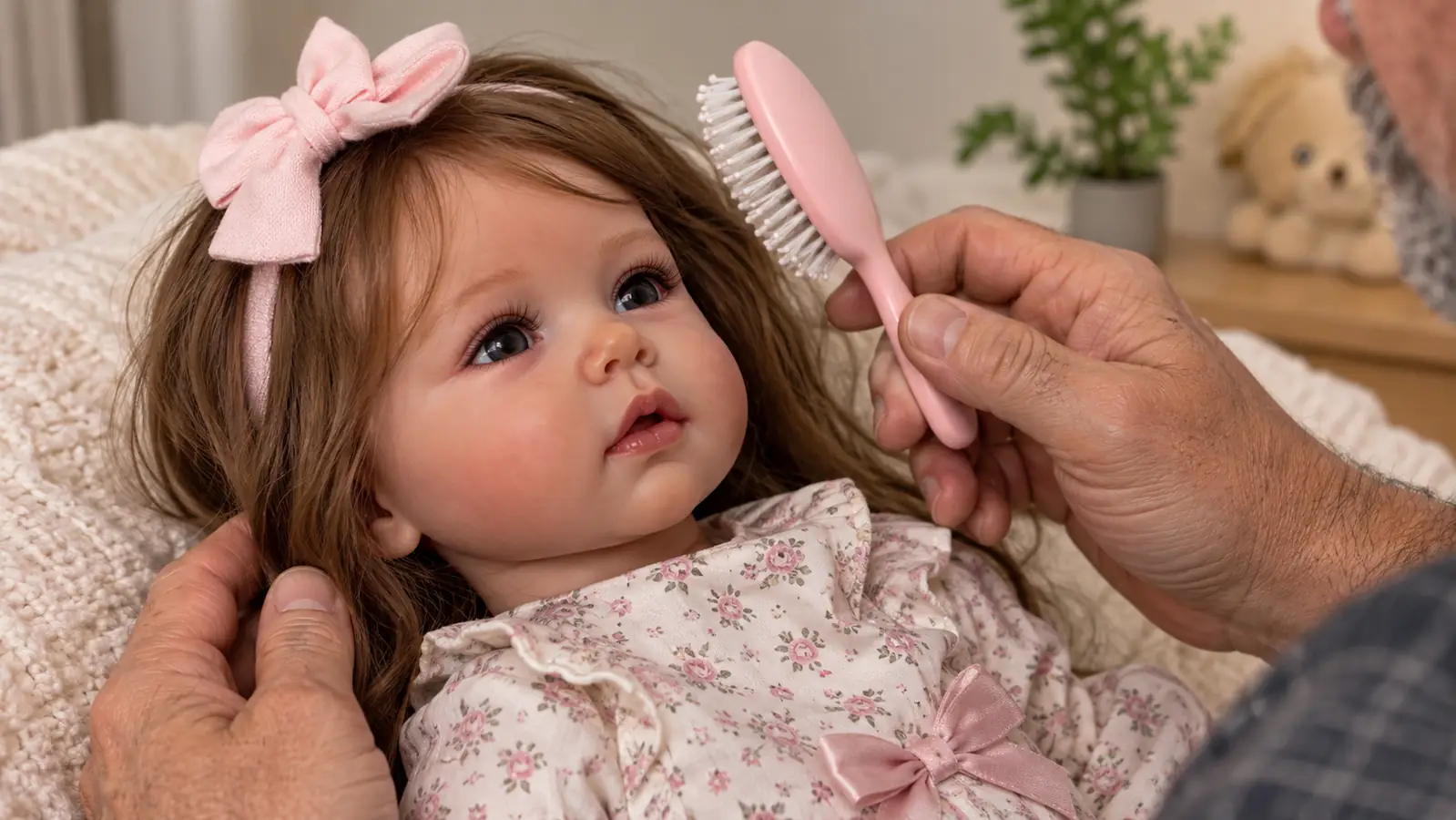
This is the habit that saved me. I cradle Lily's head in one hand, with my fingers supporting the back of her scalp, and I brush with the other. The head is not going to tip or wobble, and the vinyl is not taking any strain. The hair is rooted into that vinyl, so if the head moves while the brush pulls, the roots lose.
I also work in small sections. I lift a thin section of hair away from her head with my free hand, hold it gently near the ends, and brush from the ends upward. That sounds backwards, but it is the whole trick. The bristles work out the bottom tangles first, then the next ones up, so the brush never has to drag through a knot.
The curved handle on this brush helps more than I expected. It fits my hand like a small grooming tool, and because it is child-sized, I can see exactly where the bristles are touching. There is no guessing. I can place the brush exactly where I want it, one small section at a time.
The brush itself is small, 5.9 inches long and about 1.1 inches wide, and it weighs only 1.6 ounces. That sounds like a child's toy until you hold it. The oblong plastic handle fits right in my palm, and the nylon bristles are dense enough to do real work. I learned why the head has to stay still one afternoon in April. Lily was propped against the edge of the bassinet while I brushed, and her head tipped forward just as I pulled. I felt a strand give at the root before I could stop. It was one strand, and nobody else would ever notice it, but I noticed. After that I always cradle her head with my whole hand, thumb on one side and fingers on the other, so the vinyl cannot move at all. It slows me down, but slow is the whole point when the hair is rooted into vinyl.
Step 3: Brush from the ends up, in short strokes
I start at the very bottom of a section, about an inch from the ends, and take a short stroke downward. Then I move up a little and do it again. Each stroke only travels a short distance, so the bristles are never fighting a long tangle. Little by little, the section loosens from the bottom to the top.
The bristles on this brush are nylon, and they are firm enough to do the work but smooth enough to glide. I do not press down. I let the weight of the brush do the job. If a stroke catches, I stop and hold the hair above the snarl with my fingers, then brush the snarl out from underneath. Pulling through it is how frizz starts.
When the section finally moves without catching, I brush it once or twice from root to end to smooth it. That last pass is what makes the hair lay down flat instead of puffing up. Then I move to the next section and do the same thing. Yes, it takes longer than a quick swipe. That is the point.
In May I crocheted Lily a little knit cap, the kind with a rolled brim, and I was proud of it. By the next morning the hair at her crown had matted against the yarn in a flat patch about the size of a quarter. I did not panic, but I came close. For two days I worked that patch with short strokes from underneath, holding the hair above the snarl with my fingers, letting the nylon bristles tease it apart a few strands at a time. It came out clean, with no visible thinning, and the cap now lives in the basket with her spare outfits. That is when I understood why the short stroke matters. Patience is not a virtue here, it is a technique. A long stroke through a matted patch drags the whole tangle against the roots. A short stroke only ever works on the tangle in front of the bristles.
Step 4: Work out stubborn snarls with a little water
Every once in a while, a snarl shows up that will not budge. Usually it is at the nape, where the hair rubs against a collar or a blanket. When that happens, I do exactly what the brush listing suggests: I spray a little bit of water on the knot and let it soften before I work it out.
I use a clean spray bottle set to a fine mist, and I only dampen the snarl itself, not the whole head. Then I wait a minute or two. The water relaxes the strands just enough that the snarl comes apart with the same short, gentle strokes from underneath. I never pull, and I never rake the brush through a dry knot.
After the snarl is out, I let the hair dry completely before I brush it again. Wet synthetic hair is more fragile than dry hair, and brushing it too soon can stretch the strands. Patience here saves you from frizz later.
The worst snarl I have dealt with came in July, during a stretch of hot, humid weather. Lily had been lying on a folded flannel blanket I had made, and the nape hair had rubbed into a knot about the size of my thumbnail. I sprayed it with a fine mist and waited two full minutes while the water soaked in. Then I held the knot between my thumb and forefinger and worked it apart from underneath with the same short strokes. It took about ten minutes, and when it was done the hair looked untouched. I have never had to cut a snarl out, and I hope I never do. That is what the water step is for. It softens the strands so the brush can separate them instead of breaking them. I write that down for you because the first time a snarl like that shows up, your instinct will be to pull. Do not. Walk to the sink, fill the spray bottle, and give the water a chance.
Step 5: Finish with a light smoothing pass
Once every section is tangle-free, I do one last pass over the whole head. I brush from the crown down, following the way the hair naturally falls, with the same light pressure. This is the pass that makes her hair look like it did when she arrived, soft and shiny instead of brushed-out and fluffy.
I also pay attention to the hairline, especially around the face. That is where rooting shows the most, and where a heavy hand does the most damage. A few light strokes along the hairline, going the direction the hair grows, keeps the part looking natural.
Then I lay her back in her white wicker bassinet in the spare bedroom, away from the window, and I put the brush in the basket with her spare outfits. It takes me less than five minutes now. Most mornings I do it while I am talking to my husband about the day, and it has become one of those small rituals I look forward to.
What Else Helps
A good brush is only part of the routine. I keep Lily's hair out of trouble in the first place by storing her in the bassinet with her head on a soft folded blanket, so the back of her hair does not rub against the wicker. I also avoid dressing her in anything with a rough collar that catches the nape. And when I make her a new outfit, I choose fabrics that are smooth against the hairline.
I keep the brush clean too. Every couple of weeks I wipe the bristles with a slightly damp cloth and let it dry, so no dust or product builds up. It is a small thing, but clean bristles glide better than dirty ones, and this brush is durable enough to last for years if I take care of it.
And I will tell you what I tell every new collector who asks: you do not need a drawer full of brushes. You need one good one, used gently, in the right order. Start dry, hold the head, work from the ends up, use water only on the stubborn snarls, and finish with a light smoothing pass. That routine has kept Lily's hair beautiful for six months, and it will keep yours beautiful too.
Six months of daily brushing with Sophia's brush, and Lily's rooted hair still looks the way it did the day she came home.
Give your reborn's hair the gentle care it deserves
One child-sized brush with nylon bristles, a curved handle, and a design made for synthetic wig-like hair. This is the brush I have used every day since March.
Amazon Check Today's Price on Amazon →