
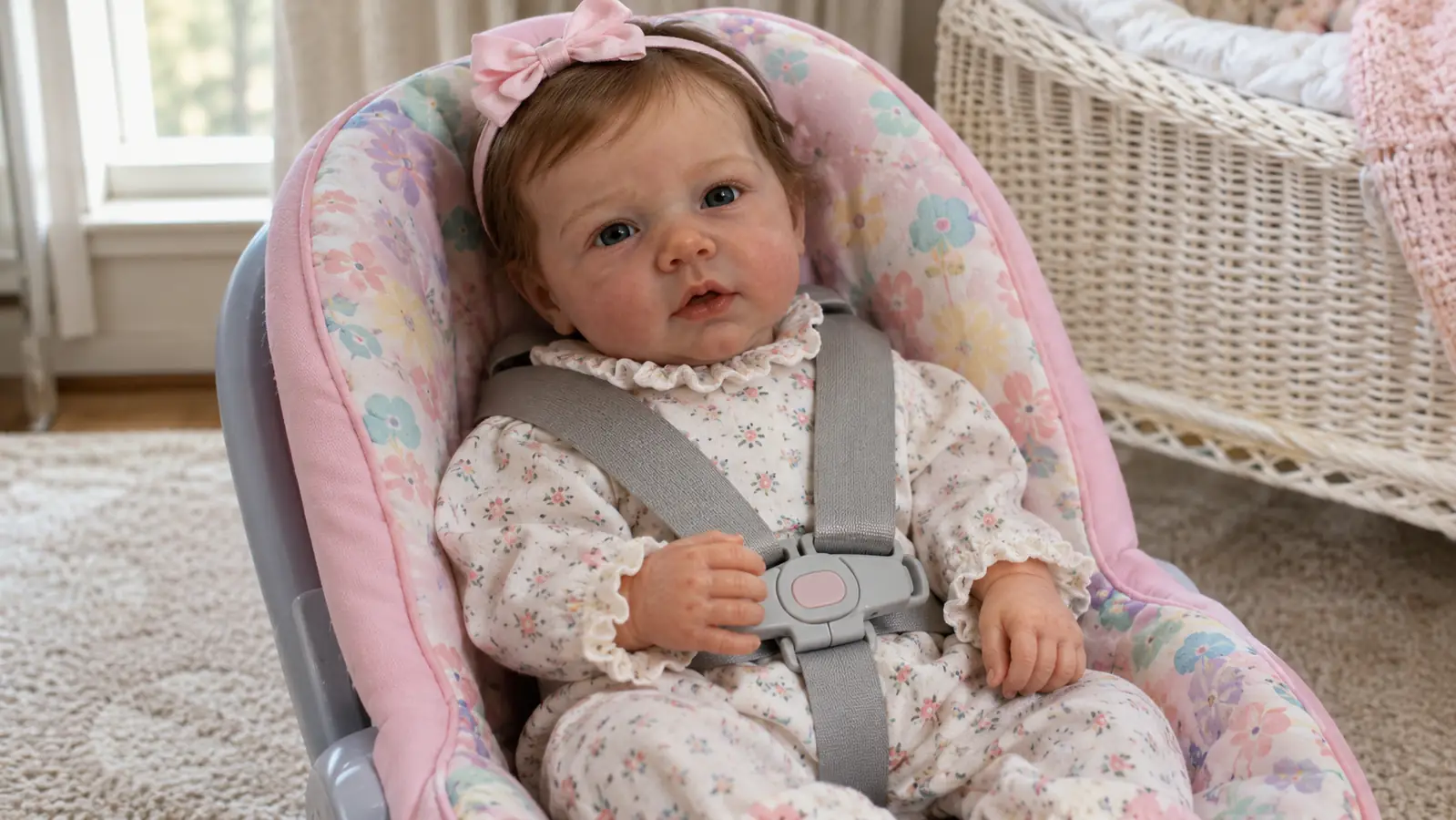
The first time I tried to carry Lily anywhere, I learned the hard way that a weighted reborn doll does not behave like a stuffed animal. She is about 5 pounds, with a weighted cloth body and vinyl limbs, and she shifts the moment you take your eyes off her. I am Marjorie Pruett, and I have spent six months, March through August, seating and carrying my 20-inch newborn girl in the Adora doll car seat carrier. This is the method I worked out so she stays put, her painted vinyl stays safe, and I do not end up chasing a rolling baby head across the floor.
The Adora carrier is the one I reach for because it was made for dolls up to 20 inches, which is exactly Lily's size, and the removable cover is machine washable. I bought it myself in the first week of March, and it has been in steady use ever since. But any carrier only works if you seat the doll correctly. Here is the step-by-step routine I use every time.
Seat your reborn safely every single time
The Adora doll car seat carrier holds dolls up to 20 inches, with adjustable safety straps and a machine washable cover. It is the carrier I have used daily since March.
Amazon Check Today's Price on Amazon →Step 1: Set the carrier on a flat, steady surface
Before I pick up Lily, I put the Adora carrier on the floor, the kitchen table, or the bed. The carrier measures 17 by 11 by 13 inches, so it needs a spot where it cannot tip. A flat surface matters more than you would think, because a weighted doll sits differently on a soft bed than on a table.
If I am at home, I usually set it on the floor near the white wicker bassinet in the spare bedroom. If I am getting ready to take her somewhere, I set it on the kitchen counter. The point is to give yourself both hands and a stable base before you lift the doll.
The one time I skipped this step was the first Saturday in April. I was in a hurry to carry Lily into the living room so my husband could see the little sundress I had sewn for her, and I set the carrier on the edge of the couch cushion instead of on the floor. The cushion gave way under the weight, the carrier tipped toward the armrest, and Lily listed sideways before I could grab her. Nothing was hurt, thank goodness, but her rooted hair caught the edge of the strap and I spent ten minutes easing it free strand by strand. I have not done that again. Now the rule is simple: floor, table, or counter, and never the edge of anything soft. The carrier measures 17 by 11 by 13 inches, so it fits easily on the kitchen counter with room to spare. When I seat her in the spare bedroom, I put the carrier on the floor right beside the white wicker bassinet. When I am getting ready to take her out, I use the kitchen counter and move the salt and pepper shakers out of the way first. Either way, I check that all four corners of the base are touching the surface before I lift Lily at all. That one check takes two seconds, and it has saved me from a whole category of accidents.
Step 2: Loosen the adjustable safety straps all the way
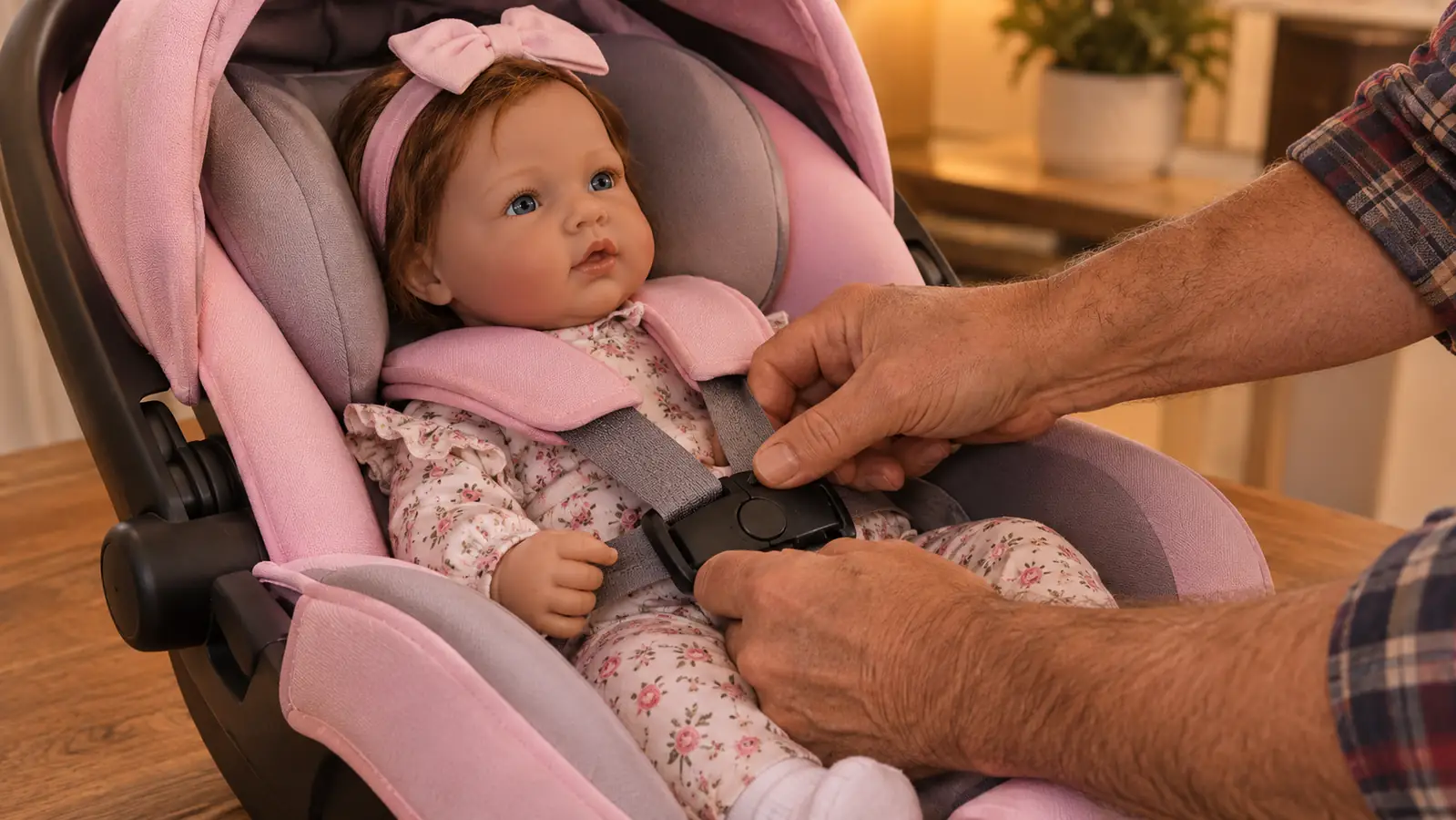
The Adora carrier has adjustable safety straps that keep the doll in place. I loosen them completely before I seat Lily. If you try to seat a weighted doll with the straps already snug, you will fight the vinyl limbs and the cloth body at the same time, and the doll will end up crooked.
Loosening the straps first also protects the doll. I am careful with Lily's painted vinyl and rooted hair, and pulling a strap across her face or arms while she is half seated is exactly the kind of thing that can catch on a painted edge. Loosen first, seat second, tighten third. That order has never failed me.
Step 3: Seat the doll from the bottom up
I support Lily's head and neck with one hand and her bottom with the other, then lower her into the carrier bottom first. Her weighted cloth body settles into the seat, and her vinyl limbs follow. I make sure her back is against the back of the carrier and her legs are not tucked under her.
Because she is a 20-inch newborn with a weighted body, she will naturally sink into the seat. That is good. Let the weight settle before you do anything else. I give her a second to find her position, then I check that her head is centered and her arms are not pinned between her body and the carrier.
The first few times, I tried to lower Lily in head first, the way you might lay a real baby into a crib. That was a mistake. Her weighted cloth body went in first and her vinyl head stayed in my hand, and the two halves did not meet in the middle. She ended up sitting on her own legs with her head tipped back against the rim of the carrier, and I had to lift her out and start over. The bottom-up method works because the weight does the work for you. Once her bottom is in the seat, the cloth body settles into the curve of the carrier, and the vinyl limbs follow naturally. I also learned to check her arms before I tighten anything. On a Tuesday in June, I seated her in a hurry before a friend came over to see my sewing room, and I did not notice that her left arm was pinned between her body and the side of the carrier. She looked fine from the front, but the vinyl arm was pressed at an awkward angle, and I only caught it when I went to smooth her dress. Now I always run a finger down both sides after she is seated to make sure her arms are lying flat against her sides. If I am taking her to a doll show, I also check that her head is centered and her chin is not tucked down against her chest, because a weighted head will rest wherever it lands and a long ride in that position could leave a crease in her neck.
Step 4: Tighten the straps in the right order
Once Lily is seated, I bring the adjustable safety straps across her and tighten them gently. I do the lower strap first, then the upper one. The lower strap keeps her bottom and hips in place, and the upper strap secures her chest without pressing on her neck.
The goal is snug, not tight. You want the doll to stay upright when you carry the carrier, but you do not want the straps to dig into the vinyl or distort the cloth body. I check by slipping one finger under each strap. If my finger fits easily, the strap is right.
The order matters more than I expected. One afternoon in July, I tightened the upper strap first because I was in a hurry to get Lily into the car for a visit to my daughter's house. The lower strap was still loose, and every time I took a step, Lily shifted sideways in the seat. By the time I reached the car, her whole body had rotated a few degrees and her dress was twisted. I had to bring the carrier back inside, loosen both straps, seat her again, and do it in the right order. The finger test has saved me more than once since then. After I tighten the lower strap, I slip one finger under it at her hip. Then I do the upper strap and check the same way at her chest. If my finger fits without pressing, the strap is snug enough. If it does not fit, I loosen it and start again. The straps are adjustable, so they will hold a smaller doll or a larger one up to the 20-inch limit, but I check the fit every single time because a weighted doll settles a little differently each time you seat her. What felt right on Monday can feel loose by Thursday, especially after the cover has been washed and the fabric has softened.
Step 5: Carry with the handle, close to your body
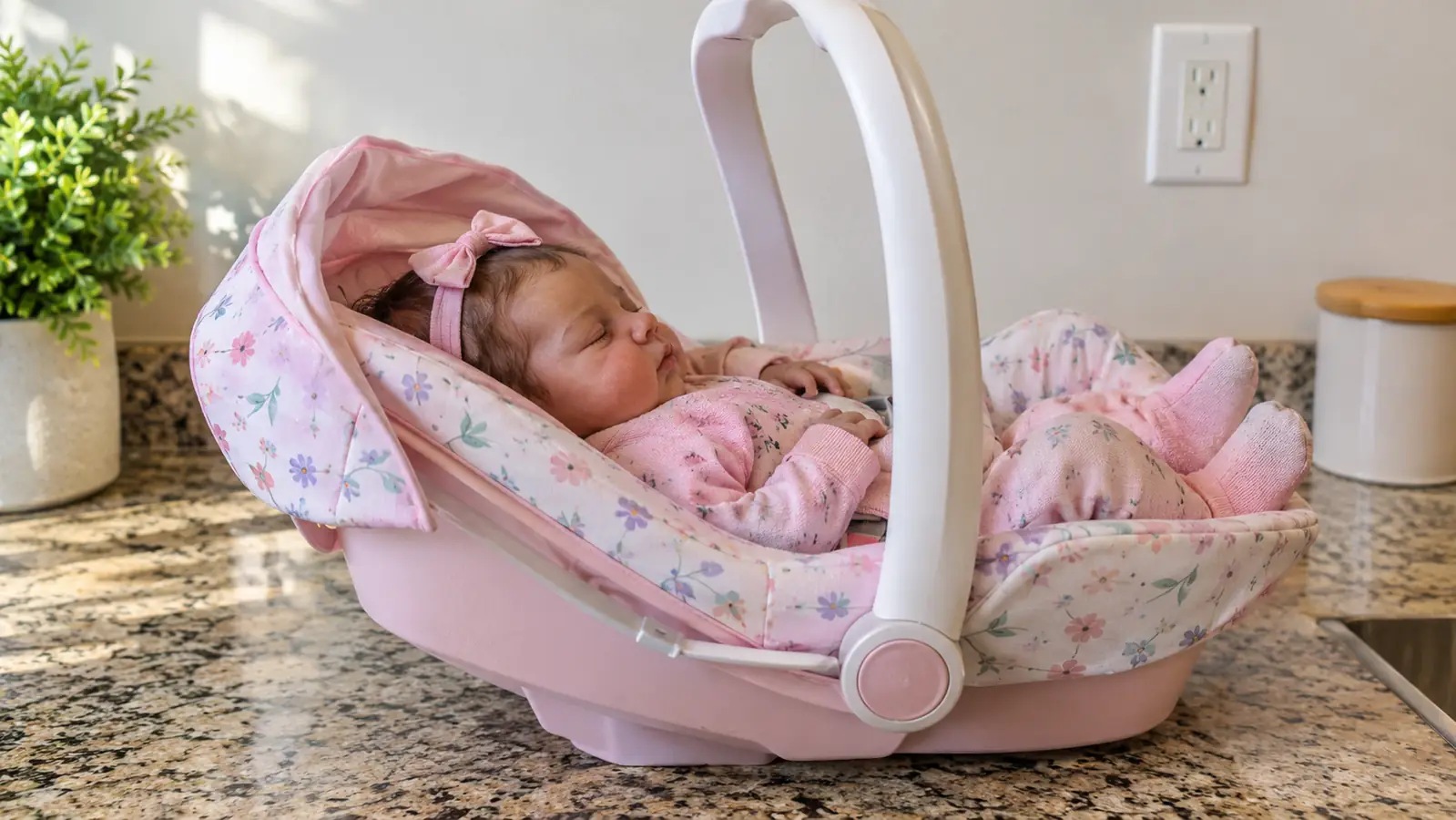
The Adora carrier has a handle, and that handle is the safest way to carry a seated doll. I lift the carrier by the handle and hold it close to my body, with the doll facing me or slightly to the side. I keep my other hand under the base of the carrier for support, especially if I am walking any distance.
Carrying the carrier close to my body means that if I bump a doorframe or a piece of furniture, the carrier takes the bump, not the doll. I also avoid swinging the carrier by the handle at my side. A 5-pound doll shifts when the carrier swings, and no strap can completely stop that.
I learned the close-to-your-body rule on a trip to a doll show in August. I carried the carrier by the handle at my side, the way you might carry a shopping bag, and Lily's weight made the carrier swing with each step. She stayed strapped in, but her head wobbled against the side of the carrier, and I could see her rooted hair rubbing the vinyl edge. I switched to holding the handle with my right hand and bracing the base with my left, with the carrier close to my ribs, and the wobble stopped completely. The handle also converts to a rocker, which is a detail I did not expect to use as much as I do. When Lily is seated and strapped in at home, I set the carrier on the floor and rock her gently while I talk to my husband or watch the evening news. It is a small thing, but it means the carrier earns its place in the spare bedroom instead of sitting in a closet between outings. I still carry her the same way every time: handle in one hand, base supported with the other, carrier close to my body, doll facing me. And when I set the carrier down, I always set it on the floor or a table, never on the edge of a bed, because the rocking base makes it even easier to tip. I also slow down at doorways and turn sideways, so the carrier goes through the opening first and the doll never leads the way into a doorframe.
What Else Helps
A few things make the whole routine easier. I keep the carrier in the spare bedroom with Lily's bassinet, so I never have to go looking for it. I also check the straps before every trip, because they can work loose in storage. And because the cover is machine washable, I toss it in the wash every couple of weeks. The carrier itself is vinyl and wipes down easily, which matters when you carry a doll to a doll show or a friend's house.
Loosen first, seat second, tighten third. That order has never failed me in six months of carrying Lily.
I have also learned to be honest about what the carrier is not. It is not a real car seat, and it was never meant to be. It is a doll accessory, made for dolls up to 20 inches, and it keeps a reborn safe and comfortable when you carry her around the house or out to a gathering. I would not use it to transport a real infant, and I would not leave a doll in it for hours in a hot car. For what it is, a practical way to carry and display a weighted reborn, it does the job well.
The carrier I have reached for every day since March
If you have a weighted reborn up to 20 inches, the Adora doll car seat carrier gives you a stable seat, adjustable straps, and a machine washable cover. It has made carrying Lily genuinely easier.
Amazon Check Today's Price on Amazon →